16

Dec
2025

Third round of North Coast Primary Care Impact Grants recipients announced

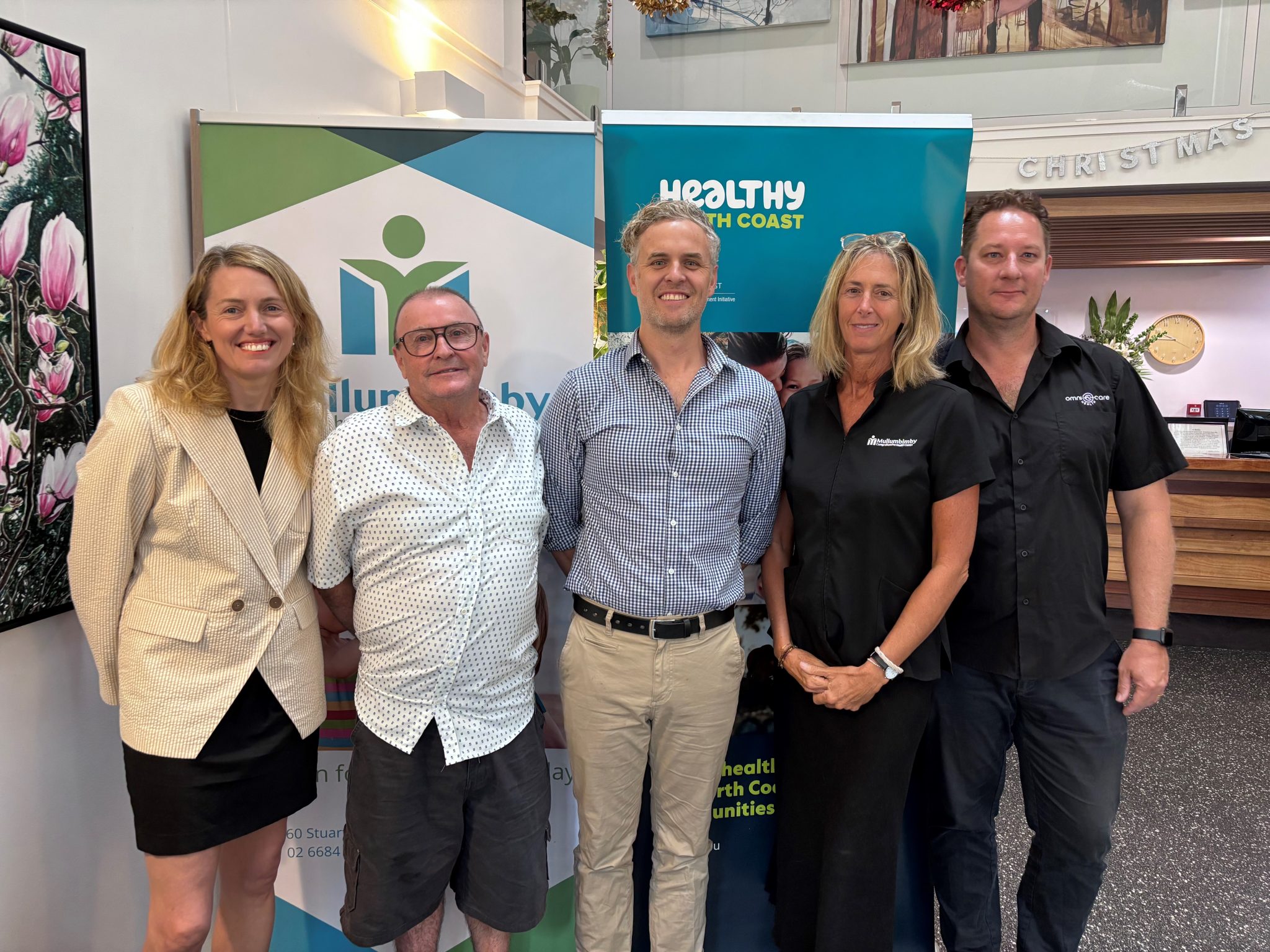
Pictured L-R: Monika Wheeler (CEO Healthy North Coast), Richie Northcott (patient), Dr Samuel Moore (Clinical Director Mullumbimby Comprehensive Health Centre), Trina Higgins (Case Conferencing Coordinator Mullumbimby Comprehensive Health Centre), Chiron Weber (Director Mullumbimby Comprehensive Health Centre).


Healthy North Coast is pleased to announce the third round of successful recipients of its Primary Care Impact Grants – innovative, locally designed projects that will support high quality care for people living with chronic and complex diseases across the region.

Following the successful first grant round announced in June 2025, and the second round announced in September 2025, 17 grants with a total value of $770,098 have been awarded in this third round, with funding going directly to general practices, Aboriginal Community Controlled Health Organisations, allied health businesses and other local providers across the Mid North Coast and Northern NSW, to test and scale creative solutions to current health care challenges.

Healthy North Coast CEO Monika Wheeler said the calibre of applications coming through the grant program continues to demonstrate the passion and innovation of local health providers:

“We are consistently impressed by the quality of models of care emerging from our region. Every round of the Primary Care Impact Grants has shown how committed our providers are to tackling chronic disease and strengthening multidisciplinary care.

“Chronic diseases remain the leading cause of death and disability in Australia, yet we know that almost 40% of this burden is preventable with earlier support and targeted action. The outstanding applications we are receiving show what’s possible when local expertise is backed with the resources to test, refine and scale practical solutions that help people stay healthier for longer.”

The Primary Care Impact Grants are part of Healthy North Coast’s commitment to strengthening the region’s primary health care system through the Australian Government’s Primary Health Network program.

$3.4m in total funding has been made available until 30 June 2027. This includes $1.8m through the MyMedicare Multidisciplinary Teams initiative and $1.6m through Primary Health Network program funding to support the management of complex and chronic diseases in high-risk populations.

Over $2.3 million has been awarded through 48 successful grants to date, with future grant rounds still to come.

Chiron Weber, Director of Mullumbimby Comprehensive Health Centre, was thrilled to be among the successful recipients in the third grant round:

“We view Multi Disciplinary Case Conferences as a continuous collaborative process. We aim to share knowledge and expertise to enhance communication, decision making, and quality of care and outcomes for patients and providers. We strongly believe that case conferencing with this multi disciplinary approach will result in a higher level of care for our patients and for the broader community as all professionals involved learn and upskill as part of the process.

“We are open to extending this service to outside GPs, and aim eventually to offer this to rural or remote GPs who are not as fortunate as we are here in the Byron Shire with access to experienced allied health practitioners.”

The Primary Care Impact Grants are designed to support continuous quality improvement in primary care. The grant applications were reviewed using an evaluation rubric that assessed community need, health equity, efficiency and feasibility of each proposal, by a panel of health experts.

Successful proposals had a data-informed and evidence-based approach to meeting the needs of their communities, with a focus on reporting outcomes to drive continuous quality improvement.

“If you’re a local health provider with an innovative idea for chronic disease prevention and management in your community, I’d encourage you to register your interest for our future grant rounds,” added Ms Wheeler.

Each grant recipient will provide valuable data back to Healthy North Coast to assist with evaluation of the program.

More information on the Primary Care Impact Grants, including for local health professionals interested in applying for future rounds, is available on Healthy North Coast’s website.


List of Round Three Primary Care Impact Grant recipients

Multidisciplinary Team Care Grants:

  • All Together Therapy, Port Macquarie – Improving the early identification and intervention of developmental, behavioural, and health concerns in children aged 0–5 years across the Hastings region – $75,000
  • Lismore Music Therapy, Lismore – Multidisciplinary therapy and support within early childhood education settings for children with developmental delays, disabilities, and neurodiversity – $75,000
  • The Grange Family Medical Centre, Port Macquarie – Structured cardiovascular risk screening, care planning, and ongoing allied health support, with exercise physiology, nutrition, and nurse-led monitoring working alongside GPs – $45,800
  • WorkforceIQ Holdings – Improving management of chronic pain in general practice by delivering a structured, accessible, and evidence-based education and coaching program – $75,000

Total Multidisciplinary Team Care Grants awarded: $270,800


Chronic Disease Prevention Grants:

  • Ballina Health Centre, Ballina – Comprehensive cardiovascular disease prevention and management model for adults aged 45–75 in Ballina – $30,000
  • Coffs Coast GP Super Clinic, Coffs Harbour – Integrated, multidisciplinary model of care for patients with Type 2 Diabetes in the Coffs Harbour region by embedding specialist and allied health expertise into general practice – $49,850
  • First Light Active, Ballina – Preventative and early intervention wellbeing model that uses a multi-disciplinary, team-based approach involving GPs, exercise physiologists, dietitians, and physiotherapists, integrating diagnostics and VALD technology to track progress – $35,000
  • Fletcher Street Cottage, Byron Bay – Trauma-informed, nurse-led drop-in clinic embedded in Fletcher Street Cottage to increase healthcare access for women experiencing or at risk of homelessness – $50,000
  • Help Prevent Falls, Coffs Harbour – Reducing the risk of falls among people aged 65+ in the Coffs Harbour region by addressing physical, educational, nutritional, and social factors – $43,148
  • Lifestyle Medicine Learning, Tweed Heads – The Sarcopenia Early Detection program seeks to identify, engage, and support adults aged 60–80 at risk of sarcopenia through early screening, targeted interventions, and ongoing evaluation – $40,000
  • Lisa Strauss Health, Ocean Shores – Group-based, dietitian-led education sessions with a focus on the prevention and management of coronary heart disease and type 2 diabetes – $24,300
  • Medical on William, Port Macquarie – Increasing the number of patients receiving comprehensive cardiovascular risk assessments by 25% within 12 months and improve long-term heart health outcomes for at-risk individuals – $25,000
  • Mullumbimby Comprehensive Health Centre, Mullumbimby – Development of a Multidisciplinary Case Conferencing service utilising staff from the Centre – $50,000
  • Northern NSW LHD Health Promotion in collaboration with Bugalwena, Bullinah, and Rekindling the Spirit Aboriginal Medical Services – Supporting the delivery of smoking and vaping cessation activities in Aboriginal Medical Services – $32,000
  • Pain Revolution – Delivering contemporary pain education and treatment by training health professionals to be Local Pain Educators – $50,000
  • Parkinson’s NSW, Coffs Harbour – Improving the quality of life for people living with Parkinson’s disease in four Residential Aged Care Facilities on the Mid North Coast – $50,000
  • Tweed Banora Medical Centre, Tweed Heads – Expanding nursing capacity to improve early detection, prevention, and management of chronic conditions – $20,000.

Total Chronic Disease Prevention Grants awarded: $499,298

More information about each of the round three grant recipients can be found on Healthy North Coast’s website.


Contact for media enquiries

Sam Brunning

Phone: 0439 968 437

Get our newsletter and events straight to your inbox. Subscribe Today

Our regional partners

  • Local Health District partners in our footprint: Mid North Coast Local Health District (MNCLHD) & Northern New South Wales Local Health District (NNSWLHD)
  • Aboriginal Medical Services (AMS)
  • The Royal Australian College of General Practitioners (RACGP)
  • Australian College of Rural and Remote Medicine (ACRRM)
  • Rural Doctors Network (RDN)
  • Rural Clinical Schools & Regional Training Hubs
  • General Practitioners
  • Registrars and International Medical Graduates
  • North Coast Allied Health Association (NCAHA)
  • Local Councils
    Pharmaceutical Society of Australia (PSA)
  • Universities including: Charles Sturt University (CSU), University of New South Wales (UNSW), Southern Cross University (SCU)

Aged Care Disaster Management Planning

Strategic Priority Area: One team

North Coast is identified as the region most likely to be impacted by climate change in Australia and also forecasted greatest growth in those 65+.

Healthy North Coast takes a lead role in ensuring the older population and the sector that supports them are prepared for, can respond to and recover from disasters and other emergencies.

We have led eight regional disaster management capacity building workshops, bringing together SES, community organisations and the aged care sector.

We have also developed disaster preparedness tip sheets for both residential and community aged care providers.

Voluntary Assisted Dying

Strategic Priority Area: One team

In May 2022, the NSW Parliament passed the Voluntary Assisted Dying Act 2022. Effective from Tuesday, 28 November 2023, eligible people have the choice to access voluntary assisted dying. 

Healthy North Coast has developed a webpage for both health professionals and consumers, with links to available information and resources.

Living with Dementia resources

Strategic Priority Area: No one is left behind

Healthy North Coast has worked with people living with dementia, their families and local service providers to develop an information booklet that will help them connect with local and national supports along their journey.

Highly regarded by a range of professional supporting those on or starting the dementia journey, the booklet includes commonly asked questions for people to ask their GP and/or specialist.

“It’s a fantastic resource and I give it to everyone on their first diagnosis. Its easy to read, so well planned and thought through and has lots of really useful information, tailored to the region.
I also find it very helpful when educating clinical staff.”

−Geropsychiatric Nurse Practitioner, Mid North Coast.

The resource is available in digital and printed copies, with more than 5,000 distributed across the region. An e-version is available to clinicians via the Dementia and Cognitive Impairment HealthPathway.

Deteriorating Resident Triage Tool

Strategic Priority Area: One team

Empowering aged care teams to deliver safer, more consistent care.

The Deteriorating Resident Triage Tool (DRRT) supports aged care staff to confidently recognise and respond to signs of resident deterioration. It enables timely, evidence-based decisions, strengthens communication with health services, and promotes early intervention and effective care planning, helping residents receive the right care, at the right time, in the right place. By doing so, it reduces unnecessary Emergency Department presentations and improves resident outcomes.

Developed in collaboration with a specialist geriatrician and informed by input from Residential Aged Care Managers, NSW Ambulance, GPs, and clinical experts across the Mid and North Coast Local Health Districts, the DRRT is practical, relevant, and aligned with contemporary best practice.

Aligned with the Strengthened Quality Standards:

  • Standard 1 – The Person: Respects resident preferences and Advance Care Directives.
  • Standard 2 – The Organisation: Strengthens governance and clinical oversight.
  • Standard 5 – Clinical Care: Supports early recognition and escalation of clinical deterioration.

North Coast care finders program

Strategic Priority Area: No one is left behind

Care finders is a free service to assist older adults connect to aged care services and supports. Care finders support older people who experience significant barriers to accessing services, and walk alongside their clients at their own pace, to understand their individual situation and support them to work through the steps to address their needs. Care finders assist people with access to other supports in the community. They can provide connections both with accessing services for the first time, and with changing or finding new services and supports if their needs change.

Care finders can:

  • Provide information about local aged care services
  • Help to set up an assessment with My Aged Care to access support, and
  • Find services that are targeted and available to help.

The care finder program has been extended to June 2029 and is provided by the following organisations. Each (Lismore, Coffs Harbour, Clarence Valley, Richmond Valley, Port Macquarie-Hastings, Kempsey, Nambucca and Bellingen) and Footprints (Kyogle, Tweed, Byron and Ballina).

icon with person and hands

Psychological services in residential aged care homes

Strategic Priority Area: Improving Lives Now

Healthy North Coast commissions two service providers to deliver psychological therapies and supports for older people with, or at risk of developing, a mental illness and who are living in residential aged care homes (RACHs).

The aim of the program is to both provide direct support to residents and their families and carers, as well as upskill the RACH workforce to respond to the needs of residents presenting with mental health concerns.

Healthy Towns. Healthy Communities.

Strategic Priority Area: Securing a Healthier Future

Connection and a sense of belonging are protective factors for both individual and community health and wellbeing. Evidence highlights that the social determinants of health play a critical role in addressing many of our regions health challenges.

That’s why Healthy North Coast has long been committed to supporting communities to strengthen and to build social health. Our initiatives, including contemporary ‘Social Prescribing’, help people to connect to activities, supports and each other, and assist communities to integrate services and bridge gaps.

icon with person and hands

Telehealth in Residential Aged Care

Strategic Priority Area: Improving Lives Now

The Royal Commission into Aged Care Quality and Safety identified several critical areas affecting aged care residents and our health system. Key challenges include:

  • Limited access to general practitioners (GPs) and allied health professionals in aged care facilities.
  • Difficulties accessing out-of-hours services

Telehealth offers valuable opportunities to enhance support for residents living in aged care homes. Funded by the Commonwealth Department of Health and Aged Care, this initiative provides telehealth equipment and staff training as part of the response to the Royal Commission’s findings.

By improving access to primary care clinicians, specialist services, and other service providers through telehealth, we can significantly enhance health outcomes for residents, reducing unnecessary hospital transfers and emergency department visits.

The selection of telehealth equipment was guided by our Healthy Ageing Strategy (HAS), a comprehensive digital discovery questionnaire, and consultation workshops with various stakeholders. These efforts included interviews with residents to understand their attitudes toward telehealth, ensuring the initiative meets their needs and preferences.

icon with person and hands

Greater Choice at Home Palliative Care Program

Strategic Priority Area: Improving Lives Now

Aims to provide people who have life limiting conditions the opportunity to exercise choice and receive high quality care at home, harnessing improved and better coordinated supports and services that meet their individual needs.

Program objectives:

  • Improve access to palliative care at home and support end-of-life care systems and services (in primary health care and community care)
  • To enable the right care at the right time and in the right place (to reduce unnecessary hospitalisation)
  • Generate and use data to support continuous improvement of services across sectors
  • Use available technologies to support flexible and responsive palliative care at home, including in the after-hours.

These objectives will contribute to achieving the following intended overarching outcomes of:

  • Improved capacity and responsiveness of services to meet local needs and priorities
  • Improved patient access to quality palliative care services in the home
  • Improved coordination of care for patients across health care providers and integration of palliative care services in their region.

Education & training funding elibility

Funding is open to all primary care providers within disaster affected communities across the Healthy North Coast footprint.

Workforce Locum support and R&R funding criteria

  • Available to primary care services in disaster impacted communities within the Healthy North Coast footprint.
  • Available to support short-term workforce coverage, allowing clinicians to rest and recover.
  • Workforce-support funding in total is capped for each site, over a 12-month period:
    • $10k for GPs and/or
    • $5K for nursing and/or
    • $5k administration support and/or
    • $5K allied/pharmacy and other.
  • Funding is not to be used to fill gaps in staffing that have not been able to recruit to and not to replace existing staff.
  • Healthy North Coast will assess requirements and approve available funding directly with the service requesting support.
  • Priority will be given to sites that have immediate, short-term workforce support needs.
  • Requests will be reviewed and supported on a case-by-case basis.
  • Program funding administered via RCTI Agreement (Recipient Created Tax Invoice) to be paid monthly, or on completion of the placement (whichever comes first).
  • Practices will be required to complete a request for payment form monthly, or on completion of the placement (whichever occurs first).

Wellbeing Flexible Funding Criteria & Eligibility

  • Open to all primary care providers within disaster affected communities across the Healthy North Coast footprint.
  • Activity must be purposeful, with the aim of increasing the wellbeing of your team.
  • Requests will be assessed on a case-by-case basis, with funding allocated based on team size.*
  • Following approval by Healthy North Coast, funding will be administered via RCTI Agreement (Recipient Created Tax Invoice) upon providing proof of expenses.
  • Funding cannot be used for the purchase of alcohol, or any other goods or services where the vendor cannot quote their Australian Business Number.
  • Planned activities must occur prior to 30th June 2024.
  • Funding will not be available for retrospective activities.
*Team Size
(Total staff and contractors)
Funding Available
Small (1-5)$500-$1500
Medium (6-20)$1500-$4000
Large (>20)$4000-$5000

Subscribe

* indicates required

Subscribe

* indicates required

Subscribe

* indicates required

Subscribe

* indicates required

Subscribe

* indicates required

Subscribe

* indicates required

Subscribe

* indicates required

Subscribe

* indicates required