19

Nov
2018

NCPHN Announces New Funding for Mental Health Services in Northern NSW

Background

The mental health and emotional well-being of all members of the community are key priorities for NCPHN. Significant work is being done to improve access to the range and level of services needed by people with mental health issues to become and remain well.

NCPHN’s commitment to improving mental health is guided by the stepped care approach – a model of care central to the Australian Government’s mental health reform agenda. Stepped care is an approach that places the person at the centre of care. It works to ensure that a person with mental health issues is able to access the right level of care at the right time.

Within the stepped care model, community-based services are available for people experiencing mild depression and or anxiety, through to people who need high levels of support to help them deal with acute mental illness.

Across our North Coast footprint, around 75,000 people are impacted by anxiety or depression with only 35% receiving treatment. Low intensity mental health services can help people to address the issues impacting their mental health and well-being. Accessing low intensity services early can prevent the need for costly intense treatment and potential hospital admission.

NCPHN provides $300k in Commonwealth funding to improve support for those with mild mental health challenges

North Coast Primary Health Network is delighted to announce that enhanced support for people with mild mental health concerns is now available on the North Coast. A new low intensity mental health service is being funded through a package of $300,000 in Commonwealth funds provided via NCPHN’s mental health and suicide prevention programs.

NCPHN has contracted community organisation New Horizons to deliver the new service that links in with the existing Northern NSW Local Health District’s Mental Health Line. The Mental Health Line is staffed by mental health professionals and receives about 1,300 calls per month. Callers are triaged according to the level of care they need. The new Low Intensity Mental Health Service provides a pathway to support that is tailored to meet the needs of people with early signs of depression and/or anxiety.
A trained Community Support Worker will provide advice to people via telephone, Skype and online chat, enabling them to access the care they need without leaving their homes or communities. The service is free.

Support may include providing information about existing services and resources, including:

  • cognitive behaviour therapy (CBT) either face-to-face, by telephone or online
  • pathways to existing local mental health services
  • links to eHealth resources including online counselling and therapy, mental health information websites, online peer support groups, and self-help applications

NCPHN Chair Dr Tony Lembke explained the need for the new service.

“Before this service, after someone rang the Mental Health Line there was a gap in care as they waited to get in to see their GP or a community mental health service. Now experienced mental health support workers will help people take advantage of the existing ehealth options and local services available to them.”

The Federal Member for Page Kevin Hogan is pleased to see Australian government funding being committed to local services that benefit North Coast communities.

“NCPHN is doing a great job to identify community needs and find the right organisations to provide access to evidence-based services. Mental health issues are a known challenge for our region. Making sure we are supporting individuals at all levels of mental health need, from mild to severe, is key to a community-wide approach.”

New Horizon’s Chief Executive Judi Higgin said the service would ensure callers were matched with the best care for their mental health needs.

“The new service complements an existing telephone service and bridges the gap in care. Early intervention can help people with anxiety and depression manage their wellbeing and prevent further escalation.”

People seeking support for mental health issues can call the Northern NSW Local Health District Mental Health Line 24 hours, 7 days on 1800 011 511.

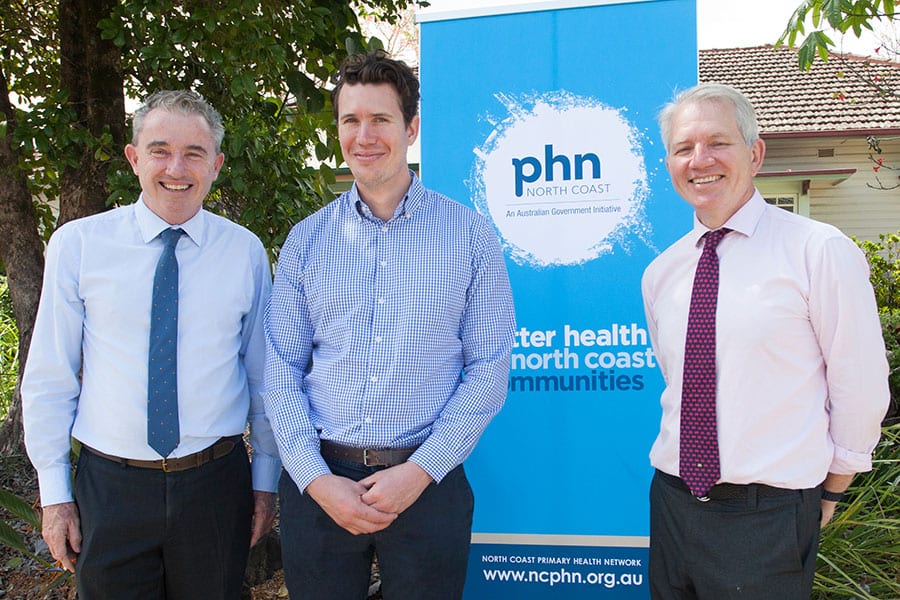
Pictured from left: Kevin Hogan MP, Peter Orr, Customer Service Manager, New Horizons and NCPHN’s Chair Dr Tony Lembke announce new funding for services for people experiencing mild depression and anxiety.

Contact for media enquiries

Janet Grist, NCPHN Media Relations Officer

Get our newsletter and events straight to your inbox. Subscribe Today

Our regional partners

  • Local Health District partners in our footprint: Mid North Coast Local Health District (MNCLHD) & Northern New South Wales Local Health District (NNSWLHD)
  • Aboriginal Medical Services (AMS)
  • The Royal Australian College of General Practitioners (RACGP)
  • Australian College of Rural and Remote Medicine (ACRRM)
  • Rural Doctors Network (RDN)
  • Rural Clinical Schools & Regional Training Hubs
  • General Practitioners
  • Registrars and International Medical Graduates
  • North Coast Allied Health Association (NCAHA)
  • Local Councils
    Pharmaceutical Society of Australia (PSA)
  • Universities including: Charles Sturt University (CSU), University of New South Wales (UNSW), Southern Cross University (SCU)

Aged Care Disaster Management Planning

Strategic Priority Area: One team

North Coast is identified as the region most likely to be impacted by climate change in Australia and also forecasted greatest growth in those 65+.

Healthy North Coast takes a lead role in ensuring the older population and the sector that supports them are prepared for, can respond to and recover from disasters and other emergencies.

We have led eight regional disaster management capacity building workshops, bringing together SES, community organisations and the aged care sector.

We have also developed disaster preparedness tip sheets for both residential and community aged care providers.

Voluntary Assisted Dying

Strategic Priority Area: One team

In May 2022, the NSW Parliament passed the Voluntary Assisted Dying Act 2022. Effective from Tuesday, 28 November 2023, eligible people have the choice to access voluntary assisted dying. 

Healthy North Coast has developed a webpage for both health professionals and consumers, with links to available information and resources.

Living with Dementia resources

Strategic Priority Area: No one is left behind

Healthy North Coast has worked with people living with dementia, their families and local service providers to develop an information booklet that will help them connect with local and national supports along their journey.

Highly regarded by a range of professional supporting those on or starting the dementia journey, the booklet includes commonly asked questions for people to ask their GP and/or specialist.

“It’s a fantastic resource and I give it to everyone on their first diagnosis. Its easy to read, so well planned and thought through and has lots of really useful information, tailored to the region.
I also find it very helpful when educating clinical staff.”

−Geropsychiatric Nurse Practitioner, Mid North Coast.

The resource is available in digital and printed copies, with more than 5,000 distributed across the region. An e-version is available to clinicians via the Dementia and Cognitive Impairment HealthPathway.

Deteriorating Resident Triage Tool

Strategic Priority Area: One team

Empowering aged care teams to deliver safer, more consistent care.

The Deteriorating Resident Triage Tool (DRRT) supports aged care staff to confidently recognise and respond to signs of resident deterioration. It enables timely, evidence-based decisions, strengthens communication with health services, and promotes early intervention and effective care planning, helping residents receive the right care, at the right time, in the right place. By doing so, it reduces unnecessary Emergency Department presentations and improves resident outcomes.

Developed in collaboration with a specialist geriatrician and informed by input from Residential Aged Care Managers, NSW Ambulance, GPs, and clinical experts across the Mid and North Coast Local Health Districts, the DRRT is practical, relevant, and aligned with contemporary best practice.

Aligned with the Strengthened Quality Standards:

  • Standard 1 – The Person: Respects resident preferences and Advance Care Directives.
  • Standard 2 – The Organisation: Strengthens governance and clinical oversight.
  • Standard 5 – Clinical Care: Supports early recognition and escalation of clinical deterioration.

North Coast care finders program

Strategic Priority Area: No one is left behind

Care finders is a free service to assist older adults connect to aged care services and supports. Care finders support older people who experience significant barriers to accessing services, and walk alongside their clients at their own pace, to understand their individual situation and support them to work through the steps to address their needs. Care finders assist people with access to other supports in the community. They can provide connections both with accessing services for the first time, and with changing or finding new services and supports if their needs change.

Care finders can:

  • Provide information about local aged care services
  • Help to set up an assessment with My Aged Care to access support, and
  • Find services that are targeted and available to help.

The care finder program has been extended to June 2029 and is provided by the following organisations. Each (Lismore, Coffs Harbour, Clarence Valley, Richmond Valley, Port Macquarie-Hastings, Kempsey, Nambucca and Bellingen) and Footprints (Kyogle, Tweed, Byron and Ballina).

icon with person and hands

Psychological services in residential aged care homes

Strategic Priority Area: Improving Lives Now

Healthy North Coast commissions two service providers to deliver psychological therapies and supports for older people with, or at risk of developing, a mental illness and who are living in residential aged care homes (RACHs).

The aim of the program is to both provide direct support to residents and their families and carers, as well as upskill the RACH workforce to respond to the needs of residents presenting with mental health concerns.

Healthy Towns. Healthy Communities.

Strategic Priority Area: Securing a Healthier Future

Connection and a sense of belonging are protective factors for both individual and community health and wellbeing. Evidence highlights that the social determinants of health play a critical role in addressing many of our regions health challenges.

That’s why Healthy North Coast has long been committed to supporting communities to strengthen and to build social health. Our initiatives, including contemporary ‘Social Prescribing’, help people to connect to activities, supports and each other, and assist communities to integrate services and bridge gaps.

icon with person and hands

Telehealth in Residential Aged Care

Strategic Priority Area: Improving Lives Now

The Royal Commission into Aged Care Quality and Safety identified several critical areas affecting aged care residents and our health system. Key challenges include:

  • Limited access to general practitioners (GPs) and allied health professionals in aged care facilities.
  • Difficulties accessing out-of-hours services

Telehealth offers valuable opportunities to enhance support for residents living in aged care homes. Funded by the Commonwealth Department of Health and Aged Care, this initiative provides telehealth equipment and staff training as part of the response to the Royal Commission’s findings.

By improving access to primary care clinicians, specialist services, and other service providers through telehealth, we can significantly enhance health outcomes for residents, reducing unnecessary hospital transfers and emergency department visits.

The selection of telehealth equipment was guided by our Healthy Ageing Strategy (HAS), a comprehensive digital discovery questionnaire, and consultation workshops with various stakeholders. These efforts included interviews with residents to understand their attitudes toward telehealth, ensuring the initiative meets their needs and preferences.

icon with person and hands

Greater Choice at Home Palliative Care Program

Strategic Priority Area: Improving Lives Now

Aims to provide people who have life limiting conditions the opportunity to exercise choice and receive high quality care at home, harnessing improved and better coordinated supports and services that meet their individual needs.

Program objectives:

  • Improve access to palliative care at home and support end-of-life care systems and services (in primary health care and community care)
  • To enable the right care at the right time and in the right place (to reduce unnecessary hospitalisation)
  • Generate and use data to support continuous improvement of services across sectors
  • Use available technologies to support flexible and responsive palliative care at home, including in the after-hours.

These objectives will contribute to achieving the following intended overarching outcomes of:

  • Improved capacity and responsiveness of services to meet local needs and priorities
  • Improved patient access to quality palliative care services in the home
  • Improved coordination of care for patients across health care providers and integration of palliative care services in their region.

Education & training funding elibility

Funding is open to all primary care providers within disaster affected communities across the Healthy North Coast footprint.

Workforce Locum support and R&R funding criteria

  • Available to primary care services in disaster impacted communities within the Healthy North Coast footprint.
  • Available to support short-term workforce coverage, allowing clinicians to rest and recover.
  • Workforce-support funding in total is capped for each site, over a 12-month period:
    • $10k for GPs and/or
    • $5K for nursing and/or
    • $5k administration support and/or
    • $5K allied/pharmacy and other.
  • Funding is not to be used to fill gaps in staffing that have not been able to recruit to and not to replace existing staff.
  • Healthy North Coast will assess requirements and approve available funding directly with the service requesting support.
  • Priority will be given to sites that have immediate, short-term workforce support needs.
  • Requests will be reviewed and supported on a case-by-case basis.
  • Program funding administered via RCTI Agreement (Recipient Created Tax Invoice) to be paid monthly, or on completion of the placement (whichever comes first).
  • Practices will be required to complete a request for payment form monthly, or on completion of the placement (whichever occurs first).

Wellbeing Flexible Funding Criteria & Eligibility

  • Open to all primary care providers within disaster affected communities across the Healthy North Coast footprint.
  • Activity must be purposeful, with the aim of increasing the wellbeing of your team.
  • Requests will be assessed on a case-by-case basis, with funding allocated based on team size.*
  • Following approval by Healthy North Coast, funding will be administered via RCTI Agreement (Recipient Created Tax Invoice) upon providing proof of expenses.
  • Funding cannot be used for the purchase of alcohol, or any other goods or services where the vendor cannot quote their Australian Business Number.
  • Planned activities must occur prior to 30th June 2024.
  • Funding will not be available for retrospective activities.
*Team Size
(Total staff and contractors)
Funding Available
Small (1-5)$500-$1500
Medium (6-20)$1500-$4000
Large (>20)$4000-$5000

Subscribe

* indicates required

Subscribe

* indicates required

Subscribe

* indicates required

Subscribe

* indicates required

Subscribe

* indicates required

Subscribe

* indicates required

Subscribe

* indicates required

Subscribe

* indicates required