
01
May
2018
For the first time, a We-Yarn Suicide Awareness & Prevention Workshop was held on Bundjalung country recently in Northern NSW, at Minyon Falls. The outdoor setting was suggested by Rekindling the Spirit, the Lismore-based Aboriginal community organisation working with The Centre for Rural and Remote Mental Health (CRRMH) to organise We-Yarn workshops on the North Coast.
Four We-Yarn workshops have been held so far on country in Northern NSW. During May and June further workshops will be held at Jubullum, Lismore, Ballina, Grafton and Casino.
Those who took part in the Minyon Falls workshop report that the event was a valuable and memorable experience with the relaxed outdoors setting promoting a feeling of belonging and openness. Such feelings are essential to the success of We-Yarn workshops where people share very personal experiences and need to feel nurtured and safe.
North Coast Primary Health Network (NCPHN) has contracted CRRMH to run a series of workshops within Aboriginal communities across the North Coast. We-Yarn is one of several programs adopted on the North Coast to address high suicide rates in our Aboriginal communities.
NCPHN funds health services and programs that are specifically designed to address local gaps identified through our regular needs assessments.
We-Yarn is led by two facilitators – former NRL player Nathan Blacklock, and Fiona Livingstone, Suicide Prevention Program Manager for CRRMH.
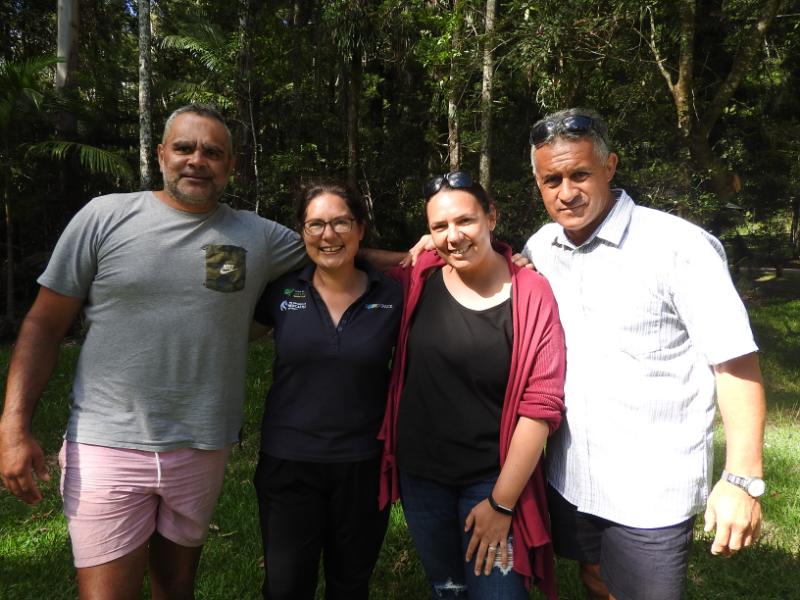
We-Yarn workshops are designed in partnership with Aboriginal health workers and community members. They are based on the idea that people who are thinking about suicide usually do give signs that they are in a bad space. Those around them can learn to recognise these signs and to offer the help and support needed.
Sadly, the rate of suicide among Aboriginal and Torres Strait islander people is much higher than for non-Indigenous Australians. There’s an urgent need to address this issue in rural communities where the majority of suicides take place.
We-Yarn aims to inspire communities to become healthier on all levels, including social and emotional wellbeing. Participants have also reported that the workshop has helped them to deal with their own experience of suicide (either themselves or family and friends).
Recent participants said that the three main things they got out of the We-Yarn workshop were:
We-Yarn co-facilitator Nathan Blacklock said he’d observed that it was easier for participants to relate to what’s happened in their life and their wellbeing when they are on country.
“It was good to be sitting in a circle. Usually Fiona and I are sitting out in front. In a circle everyone’s connecting with each other and people can see each other and nod in response to what someone’s saying.
“That’s where the healing can take place. For something personal to you, something that needs healing, it’s best to be in a circle outdoors. Mother Earth looks after us.”
Co-facilitator Fiona Livingstone has also noticed a greater connection in the on country workshops.
“It’s relaxing to be outdoors and when you are talking about something as sensitive as suicide prevention people need to feel safe about opening up. Being outdoors is better than the classroom style where people are more likely to close down. At the first on country workshop we held I noticed that we hugged each other when we were saying goodbye, because of the level of connection we felt with each other. And that didn’t happen in the classroom style workshops. And it was because we were on country.”
NCPHN’s Mental Health Reform Senior Project Officer Jack de Thierry’s Maori heritage means he has a particular affinity with Aboriginal people, and he recently took part in a We-Yarn Suicide Prevention Training workshop to better understand what is being done to address the issue of suicide in our Aboriginal communities.
“I took a lot away from that workshop. Being on country really helped people connect and open up. It was a privilege to hear people’s stories and how their experiences had affected their lives,” he said.
Rekindling the Spirit’s Comorbidity Coordinator Sharmaine Keogh attended the recent workshop and highly recommends We-Yarn to others in the Aboriginal community.
“I liked how the program was delivered, it was important to deliver the program with sensitivity considering the nature of the topic and I felt that this was done well. I enjoyed hearing the sad but rich stories from the participants … it brought the subject home.
“I felt that it was great to have the program held outdoors, it gives a sense of freedom and connection, I feel all group programs benefit enormously when held outdoors. The facilitator knew her subject matter and sharing her own experience humanised the topic and I feel it gave permission for other participants to disclose if they wished. I would surely recommend the workshop to other people.”
Practice Manager of Jullums Aboriginal Medical Service in Lismore, Vickie Williams, thought the We-Yarn workshop was outstanding.
“You sit in a circle around a fire and you talk and talk and before you realise it you have shared some very private thing that you always kept very close to your chest.
“We covered many topics but the most important was learning how to identify the signs that indicate someone is at risk of suicide.”
To find out more about upcoming workshops or to organise a workshop for your organisation, contact Fiona Livingstone on 02 6721 0074 or email: Fiona.livingstone@newcastle.edu.au
For anyone struggling with mental health issues, help is available by phoning:
Healthy Towns Comes to South West Rocks
Launch of 2018 Winter Strategy
Strategic Priority Area: One team
Strategic Priority Area: One team
Strategic Priority Area: No one is left behind
Strategic Priority Area: One team
Strategic Priority Area: No one is left behind
Strategic Priority Area: Improving Lives Now
Strategic Priority Area: Securing a Healthier Future
Strategic Priority Area: Improving Lives Now
Strategic Priority Area: Improving Lives Now