

Telehealth in Residential Aged Care
Telehealth provides opportunities to better support residents living in aged care homes. This initiative is funded by the Commonwealth Department of Health and Aged Care, which includes the provision of telehealth equipment and training for staff, as part of their response to the Royal Commission into Aged Care Quality and Safety.
Supporting access to primary care clinicians, specialist services and other service providers in aged care homes through telehealth will improve health outcomes for residents, avoiding unnecessary hospital transfers and ED presentations.
The choice of telehealth equipment was informed by our Healthy Ageing Strategy (HAS), our Digital discovery questionnaire and further consultation workshops with a range of stakeholders, including interviews with residents on attitudes toward telehealth.
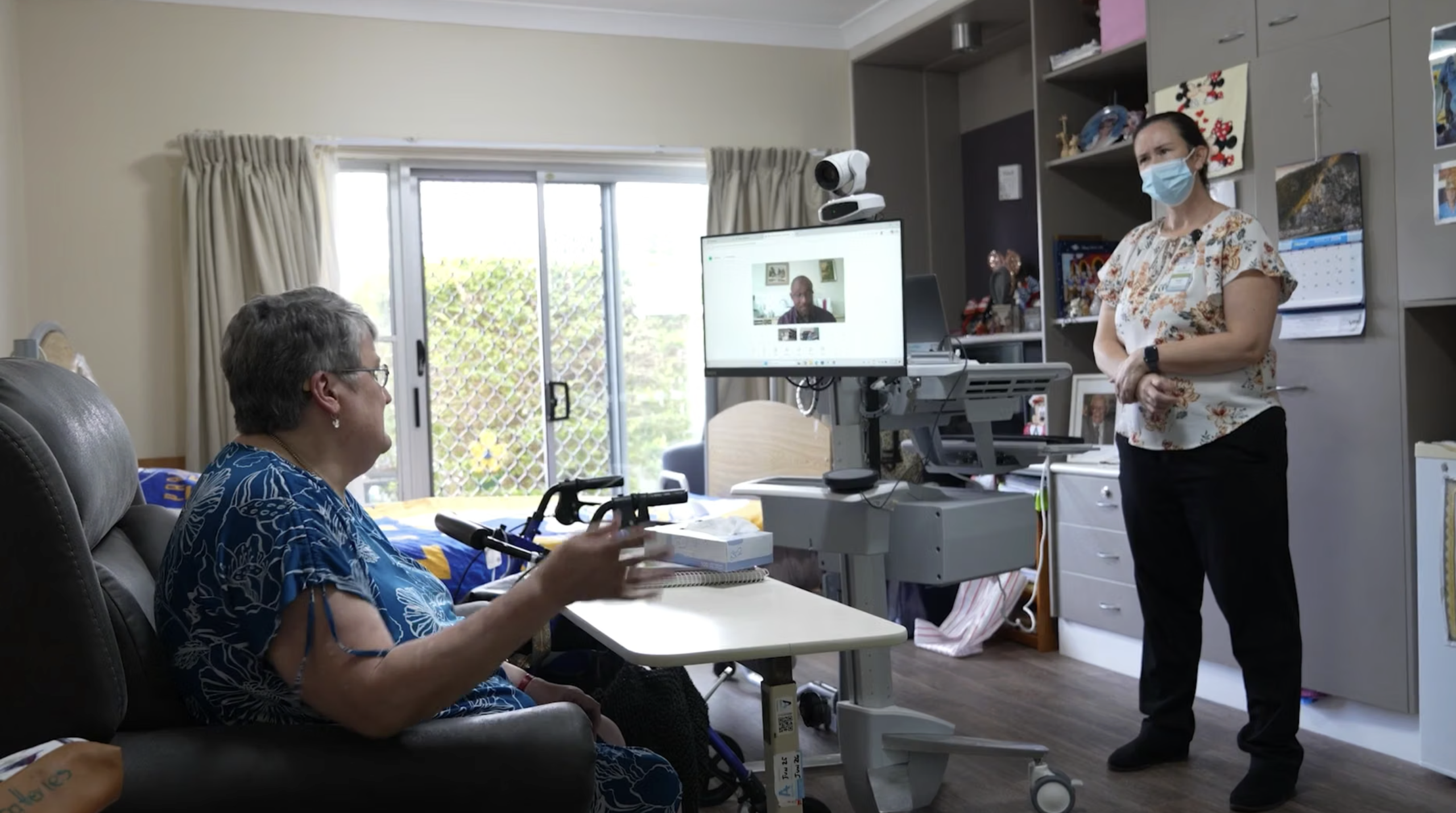
Telehealth in action | Vincent Court, Kempsey
Our local offering
Our findings from the digital discovery questionnaire clearly showed that a ‘one size fits all’ approach would not be effective. Residential Aged Care Homes (RACHs) in our region have varying levels of digital maturity and connectivity capabilities. However, participants in the consultation workshops widely recognised virtual care models as crucial for healthy ageing and access to services, with strong support for remote patient monitoring.
Considering these insights, Healthy North Coast proposed a tiered approach to support all RACHs, regardless of their capabilities or capacity. Through an Expression of Interest (EOI) process, RACHs selected the option they felt best suited their needs and capacity to implement.
As a result, 78% of Residential Aged Care Homes opted to participate and have now received telehealth equipment. Most participating RACHs have received laptops and/or iPads, while 11 RACHs have chosen to implement the more advanced remote diagnostic system, Visionflex Telehealth Cart.
Building confidence and skills to use telehealth
Healthy North Coast (HNC) has invested significantly in supporting RACH nurses, GPs, and other service providers to enhance their comfort and capabilities in telehealth. While technology acts as an enabler, education is crucial for helping healthcare professionals develop the skills to assess the clinical appropriateness and effectiveness of telehealth. This ensures that residents receive the best possible care in a timely and appropriate manner.
Education initiatives as part of the Telehealth in Aged Care project
Along with 15 other PHNs, Healthy North Coast (HNC) has invested in a National Telehealth Training Program to provide standardised training for RACH staff and service providers. This initiative supports aged care homes by ensuring that nurses and service providers approach telehealth delivery with a consistent level of understanding, comfort, and clinical standards.
These modules will be available for nurses on the Aged Care Quality and Safety learning management system (LMS) – ALIS.
(COMING SOON) Healthy North Coast will also provide local access to these modules for RACH staff and service providers, including General Practitioners, Allied Health professionals, Specialists, and other service providers.
Visit the Telehealth Training Program – PHN Telehealth Training website to learn more.
Healthy North Coast (HNC) has commissioned the nurse education specialist, Primary Care Innovation (PCI), to support Residential Aged Care Homes (RACHs) across the region. PCI is developing customised education plans for each RACH to help staff build confidence and capacity in using telehealth. These education plans will also enhance nursing skills in using HealthPathways and MyHealth Record, as well as advance care planning, palliative care, and triaging residents’ deteriorating health.
Glaser (2022) states that most digital transformations take years and require several iterations, which typically arise from learnings and experience. A Community of Practice offers members a platform to share their experiences and learn from each other, potentially accelerating the digital transformation process.
According to Glaser (2022), there are three factors that contribute to successful digital transformation: (1) defining the transformation before selecting the technology, (2) innovating the business model to leverage new technologies, and (3) managing the process of organisational change.
Healthy North Coast (HNC) plays a crucial role in supporting shared discussions, discovery, and learning. It provides best practices, guidelines, and change management strategies for members to utilise. HNC ensures that clinical and business changes are at the forefront of discussions, with technology acting as the enabler of digital transformation.
Source: Glaser J, PhD, Shaw S, MD, PhD (2022). “Digital Transformation Success: What Can Health Care Providers Learn from Other Industries?” NEJM Catalyst.
Case study 1
An 89-year-old female resident experienced a fall at their RACH, resulting in a fractured neck of femur. Following her treatment, her follow-up appointments were conducted via telehealth with the Local Health District (LHD) fracture clinic.
This innovative approach has yielded significant benefits:
- Enhanced Comfort and Convenience: By leveraging telehealth services, the resident avoided the need for a strenuous trip in an ambulance and the discomfort associated with a day-long visit to the clinic.
- Cost Savings: Utilising telehealth eliminated the expenses associated with ambulance transportation and the need for a staff member to accompany the resident to the clinic, thereby reducing overall healthcare costs.
This case exemplifies how telehealth not only improves patient experience and convenience but also offers cost-effective solutions while ensuring continuity of care.
Case study 2

Vincent Court Aged Care Community in Kempsey has had great success adopting the Visionflex telehealth carts to provide timely access to GP assessments.
With the availability of general practitioner face-to-face appointments declining in Kempsey, Vincent Court needed to explore a different model to ensure residents received the best care to maintain routine and urgent medical appointments.
Vincent Court embraced the opportunity to plug fill this gap by establishing a hybrid model of care with a GP based in Grafton. Once a week, this GP conducts telehealth appointments using the Visionflex technology, and supplements this with on-site visits once a month.
Visionflex is a telehealth service provided by Healthy North Coast, as part of a program to help aged care residents across the region access timely quality care through telehealth technology and practitioner training.
“Visionflex goes much further than an iPad telehealth service. It actually simulates a real GP surgery, with a large, high-definition screen that enables clearer communication between the resident and their GP. Importantly, the technology enhances diagnostic capabilities so the GP can make more informed clinical decisions.”
“We are finding that we can better manage health outcomes for residents in their home, with the aim of preventing escalations to hospital. As part of the Apollo Care Alliance, Vincent Court is committed to embracing technology to provide the best care to residents.”
−Vincent Court Manager, Alan Pretty.
Case study 3
The Royal Freemasons Benevolent Foundation (RFBI) embraces telehealth as a means to offer equitable and accessible healthcare to its residents. By leveraging this technology, RFBI not only reduces wait times and hospital visits but also facilitates early intervention and ensures a seamless continuum of care.
According to Nurse Practitioner Amanda Woodlands, the Visionflex cart is more than just a telehealth tool;
“It is not just a telehealth cart that is able to perform visual and audio consultations. It has improved diagnostic tools that take the consultation to that next level.“
Resources
If you have any questions, please get in touch through our contact form

Join our newsletter
Join