
What is a Primary
Health Network
(PHN)?
Working together to improve health and access to care across our region
Primary Health Networks (PHNs) were established by the Australian Government in 2015.
The PHN model replaced Medicare Locals (established in 2011, with 61 regions), which replaced Divisions of General Practice (established in 1992, with 120 divisions).
PHNs are responsible for driving local innovation to meet specific local health needs and support the consistent local delivery of national and co-commissioned programs and services.
The size of the PHN program in Australia is around $2 billion – which delivers over 2,700 activities on behalf of the Australian Government. Healthy North Coast delivers the PHN program on the North Coast of New South Wales, Australia.
Frequently asked questions
PHNs deliver 3 core functions, known as ‘the 3Cs’:
- Coordinate and integrate local health care services in collaboration with Local Health Districts to improve quality of care, people’s experience and efficient use of resources.
- Commission primary care and mental health services to address population health needs and gaps in service delivery and to improve access and equity
- Capacity build and provide practice support to primary care and mental health providers to support quality care delivery
Primary care is the first service people generally go to for health care outside of a hospital or specialist. It includes diagnosis and treatment of health conditions and long-term care. Primary care also covers health promotion and prevention services.
Common types of primary care are:
- general practice
- Aboriginal Community Controlled Health Organisations
- community health centres and walk-in clinics
- community pharmacies
- community nursing services
- mental health services
- drug and alcohol treatment services
- sexual and reproductive health services
- maternal and child health services
- allied health services, such as psychologists, physiotherapists, occupational therapists, chiropractors
You may not interact with your PHN directly every day, but our work supports many of the health services and programs available across the North Coast.
For example, Healthy North Coast helps to:
- improve access to mental health support
- strengthen care for older people and people living with chronic conditions
- support Aboriginal and Torres Strait Islander health initiatives
- improve access to services in rural and remote communities
- support local health professionals through education and training
- coordinate responses during floods, bushfires and other emergencies
- invest in programs that respond to local health needs
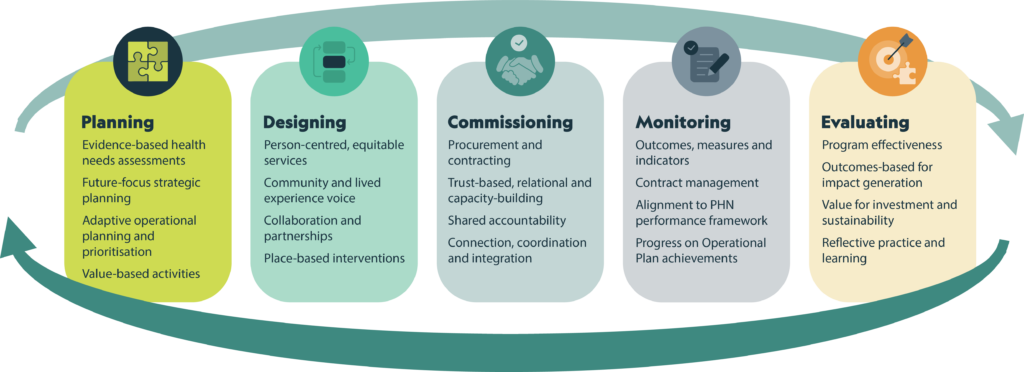
Healthy North Coast uses a ‘commissioning’ approach to improve health outcomes for our communities.
Commissioning means understanding local health needs, planning services, investing in the right solutions and evaluating outcomes to ensure programs deliver value and impact. We don’t provide health services ourselves. We procure health care providers to deliver services.
As a commissioner, this allows us to respond to emerging challenges and ensure funding is directed where it can make the greatest difference.
This diagram outlines the 5 stages of our commissioning wheel:

Working together for healthier communities
Improving health outcomes is a shared responsibility. We work closely with:
- community members
- health professionals
- local health services
- Aboriginal organisations
- community organisations
- government agencies
- service providers and partners.
Together, we are building a stronger, more connected and more equitable health system for the North Coast.
How we are governed
Healthy North Coast is a not-for-profit organisation funded by the Australian Government.
We are governed by a skills-based Board and supported by community and clinical advisory structures that help ensure our work reflects the needs of our region.
Better Health Stories
Behind every program and initiative are real people and communities benefiting from better access to care. Read stories about how partnerships, programs and local services are making a difference across the North Coast.
Read our Better Health Stories